



September 23, 2026
Behind Every Bolt
Bridge painting inspection and the technical rigor that keeps interstate structures drivable
Insights from Brad Hays and Hakim Smith, Construction Services
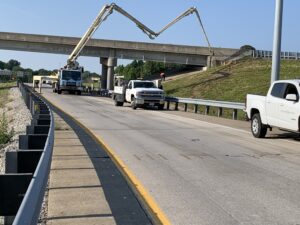
Underneath the ramps and overpasses of one of Missouri’s busiest interchanges, a crew was blasting steel back to bare metal and working day and night to keep the job moving without shutting down the interstate below.
When the dust cleared, two inspectors from H&S went in with a flashlight and a mirror. Every surface. Behind every bolt. In every corner. Before a single coat went on.
That’s what bridge painting inspection looks like on a MoDOT (Missouri Department of Transportation) project this size.
Bridge paint isn’t cosmetic. It’s a corrosion protection system. And the inspector is the last line of defense between a compliant project and a costly failure.
Not Many People Can Do This
“There’s not very many inspectors that can do this,” Brad Hays says. “It’s only Hakim (Smith) and myself for H&S. So it’s kind of specialized work.”
Brad Hays spent 30 years as a senior inspector for MoDOT before joining H&S in 2021, so he’s highly familiar with this type of work and undersells the complexity and level of specialization required. The gap between Level 1 and Level 2 certification is what makes this work rare, and it’s exactly what MoDOT is looking for when a job gets complicated.
A quick explanation on what makes this certification so special: for more than 75 years, the National Association of Corrosion Engineers (NACE) and Society for Protective Coatings (SSPC) were the two major bodies that set the standards for how steel surfaces are prepared and how protective coatings are applied and inspected on structures like bridges. They merged into a single organization, the Association for Materials Protection and Performance (AMP). AMP certifies inspectors through their Coating Inspector Program (CIP) at two levels. Level 1 covers the basics. Level 2 qualifies an inspector to conduct destructive testing to investigate failures, and oversee the most complex coating work. Destructive testing involves physically damaging the coating to verify mil thickness, adhesion, and bonding. Certification is not easy to get, and there aren’t many certified inspectors working today.
Hakim Smith brings 20 years of experience in construction administration and field inspection. His background extends beyond coatings. His ICC Special Inspector: Structural Steel and Bolting certification covers the connections and bolting in the steel itself, a layer of expertise that becomes relevant the moment a project involves bearing replacements, new diaphragms, or any structural steel work happening before the paint goes on.
Together, Brad and Hakim are the only two CIP Level 2 certified bridge coating inspectors at H&S. That number matters the moment a job gets complicated. Brad and Hakim are already bringing the next generation along — Adam Bier was part of this project team, building the experience base onsite that Level 2 certification requires. The bench grows one project at a time.
When a contractor wants to run around the clock, which is often the only way to complete a major bridge painting project on an active interstate, MoDOT requires two CIP Level 2 inspectors on site. “You can’t expect one person out there 24 hours a day,” Brad says. A lot of firms can only put one in the field. H&S can put two. That’s the difference between being able to take the job and not.
The I-270 & I-64 Bridge Bundle: Bridge Painting Inspection in Action
The I-270 and I-64 interchange in St. Louis County sees more than 100,000 vehicles daily on its busiest segment. The rehabilitation project, packaged by MoDOT into one of their “bridge bundles”, consisted of eight steel girder bridges: 302,900 square feet of steel surface preparation, 61,200 square feet of inorganic zinc primer, 302,900 square feet of intermediate field coat, and 105,800 square feet of finish field coat.
“A lot of times they’ll do a zinc coat over the entire structure, an intermediate coat over the whole thing, and only put their finish coat on the outside girder,” Brad says — the outside girder is what takes the brunt of the environmental damage, so that’s where the final layer of protection goes.
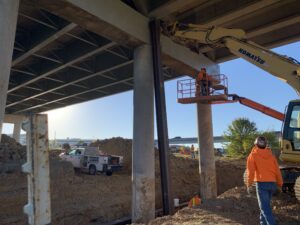
MoDOT is a proactive client. They maintain inspection records on every bridge in the state and schedule recoating work before deterioration becomes a structural problem. But the location made everything harder. The team was working in multiple environments simultaneously. Some spans over grass, some directly overactive lanes, and some on overhead ramps. Certain sections of I-270 could only be worked on weekends. Some required full ramp closures.
“That project was very fluid,” Brad says. “We had contractor crews working at multiple locations, all in different phases of cleaning, prep, and paint application, around the clock.”
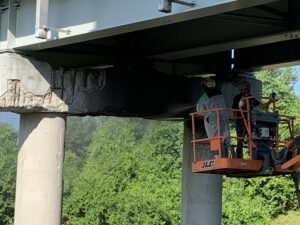
“Some of those bridges, we just did the cleaning and recoated them,” Brad says. “And then some of the bridges, we went for the whole thing. We did the blast with the blast media and took it down to bare steel and then recoated it with three coats of paint.”
H&S’s team had to be there for every shift, every phase, every inspection window.
Why Preparation Is Everything — And What Happens When It Isn’t
“Spraying the paint’s not near as much time,” Brad says. “Prep is a very large part of it.”
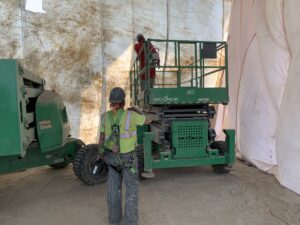
On a lead-paint bridge, the crew builds a complete enclosure around the section being worked before any blasting begins. “The contractor would spend a good 10 hours just building containment to contain the lead paint,” Hakim says, “and then it takes another five hours to take it down. And in that time, while that containment is up, that’s pretty much where we’re in and out, just to make sure everything is to spec. Because once that containment comes down, it’s going to be very expensive to go back if they need to repeat anything.” There’s also an environmental dimension. If handled incorrectly, it’s a public health problem. “Lead can get into your water system,” Brad says. “If you’re not containing it, it’s very detrimental to children.” Proper containment, proper disposal, and a licensed lead paint inspector on the team aren’t optional. They’re what protects the community around the job site, not just the bridge.
On projects involving asbestos, workers wear personal monitors and handheld equipment collects continuous readings. If limits are hit at the three-hour mark, work stops for the day. The protocol exists whether or not it’s triggered.
Inside the containment, the environment is brutal. Workers blast media in protective hoods with continuous-flow respirators fed by an external air pump. Visibility through a plastic lens is limited, as the air is thick with dust. Ventilation ducts create negative pressure, pulling the containment walls inward, shrinking the already confined space. Brad and Hakim aren’t watching from outside. They’re in there too.
When the dust settles, Brad and Hakim go in with flashlights and mirrors — checking behind bolts, in corners, at the ends of girders — marking any remaining lead paint with chalk so the crew can reclean before the inspection is signed off.
That’s the job.
And this is where having two CIP Level 2 inspectors on site pays off directly for MoDOT. On a project this size, coverage wasn’t a fixed rotation. Brad and Hakim ran overlapping 12-hour shifts, days and nights, with a 40-minute to one-hour overlap built in specifically to debrief. They’d brief each other on what was happening, what to watch for, and hand off to the foreman and crew leads for that shift. On some weekends Brad worked days and Hakim covered the rest. Two inspectors, overlapping shifts, a deliberate handoff window so nothing fell through the gap between crews.
Bridge coatings fail in predictable ways, and every one of them is preventable with the right eyes on the job:
- The steel wasn’t truly clean. Oil residue or contamination prevents bonding. Once blasted to bare steel, any remaining contamination means failure. The coating peels and the steel rusts immediately. A CIP Level 2 inspector knows that blasting to bare metal is only half the battle. They’re trained to test for oil, grease, and soluble salt contamination before any coating goes down, using methods like soluble salt testing and UV light checks. They won’t sign off on a surface that looks clean but isn’t.
- The surface profile wasn’t right. Blasted steel needs the correct microscopic texture for paint to grip. Too smooth and it won’t hold. Too rough and the peaks aren’t fully covered. Profile depth isn’t something you eyeball. A CIP Level 2 inspector uses calibrated replica tape and digital gauges to measure the anchor profile precisely, verifying it falls within the coating manufacturer’s specified range. Too smooth or too rough, and the work stops until it’s corrected.
- Weather windows were ignored. Missouri’s weather is notoriously volatile: temperature swings, sudden humidity spikes, and rapid dew point changes can cause moisture to condense on steel surfaces even after blasting. When that happens, the coating locks the problem in before it’s even dry. A CIP Level 2 inspector monitors ambient conditions continuously: air temperature, surface temperature, relative humidity, and dew point. They know the thresholds, they carry the instruments, and they have the authority to halt work when conditions fall outside spec.
- Mixing wasn’t compliant. Zinc-based primers are unforgiving and must be mixed as a complete kit, continuously, so the zinc doesn’t settle. A CIP Level 2 inspector verifies that complete kits are used, that mixing is continuous to keep zinc in suspension, and that lot numbers are recorded for every can before application begins. That documentation trail matters when a coating system needs to be defended years down the road.
- “Holidays” were missed. A holiday is a thin spot in the coating. Steel can start rusting underneath even when the surface looks uniform at a glance. A CIP Level 2 inspector uses wet film gauges during application and dry film thickness gauges after curing to verify coverage across the entire surface. They know where thin spots are most likely to hide — edges, welds, bolt heads — and they check those areas with extra scrutiny.
At each phase (blasting, priming, topcoat), work stopped at designated hold points so Brad and Hakim could verify quality before the next step began. The paint can’t fix what the prep missed, and neither can the next coat.
What does it cost when these things go wrong? “If it wasn’t cleaned properly, like if it’s got oil residue or something on it, that paint’s not going to bond. So it’s going to peel, and it’s already been blasted back to bare steel.” Once that happens, bare steel begins oxidizing immediately. The bridge won’t fail overnight. The steel is thick, but the clock starts the moment the paint lifts. And the longer it runs, the more expensive the fix.
Catch it early, and it’s mostly a matter of having the crew redo the work to correct it.
Miss it, and Brad puts it plainly: “Once the paint’s on, it’s just a matter of redoing the job a second time. So it costs double.”
A coating system that fails doesn’t just cost more to fix. It accelerates the corrosion that shortens a bridge’s service life and, eventually, its structural integrity. The people crossing this interchange every day aren’t thinking about what’s holding it together. That’s the point. The inspection work Brad and Hakim do is why they don’t have to.
What a Strong MoDOT Relationship Actually Looks Like
Ask Brad and Hakim what makes the H&S relationship with MoDOT work, and the answer is immediate.
“Communication,” Brad says. “Trust.” After 30 years on the MoDOT side of the table, he’s seen what breaks client relationships down.
“Be upfront with everything,” Hakim adds. On a job where a contractor might push to move past a failed surface check to stay on schedule, being upfront isn’t just a value. It’s the job.
“They’re going to look at these bridges, check them on a regular basis, and the quality of the paint and how everything’s holding up, that’s on us. ‘Who did that bridge? H&S.’ Our name is there. So if we put out a quality product, it’s going to last for years.”
Over 20 years, Hakim has built his own system for keeping it all straight: meetings, report forms, field books, and what he calls picture books, visual reference guides he puts together himself for the crews he works with. For Hakim, the relationships that matter most aren’t just with MoDOT, they’re with the crews and supervisors on the ground. “I think the most important thing of working any type of job is just the relationships you build with the people. If I know I’m working with supervisor A on the next project, we already have an understanding — our communications, how we communicate with each other, what needs to be done.”
Beyond certification, H&S brings something that can’t be credentialed: 30 years of Brad’s institutional knowledge of how MoDOT operates. Its documentation systems, its expectations, its standards. He knows what the client is looking for before they ask for it.
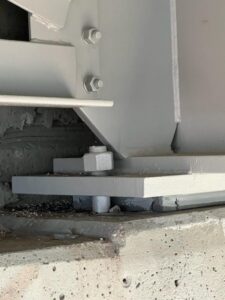
Combine that with Hakim’s ICC Special Inspector: Structural Steel and Bolting certification: where AMP covers what’s on the surface, ICC covers what’s in the steel. The connections, the bolting, the structural members underneath the paint. On the I-270/I-64 project, that credential was put to work directly in the field. The team jacked several bridges on I-64, raising them five-eighths of an inch under live traffic, to pull and replace corroded bearings before recoating. Hakim’s ability to inspect that structural steel work, not just the coating that followed, is what made H&S the right team for a project where the scope went deeper than paint.
If you manage steel structures in Missouri or Illinois, the window to catch a coating problem before it compounds is narrow, and the inspection standards are the same whether the job is on an interstate or a county road. Knowing what to look for in a qualified inspector is half the battle.
Brad Hays, Senior Construction Administrator, holds AMP CIP Level 2 certification and Missouri lead paint inspector licensure. He spent 30 years as a Senior Inspector with MoDOT before joining H&S.
Hakim Smith, Project Engineer, holds AMP CIP Level 2 certification, ICC Special Inspector: Structural Steel and Bolting certification, and Missouri asbestos and lead paint inspector licenses.